
Analysis
The Agentic Handshake & The Digital Register: How MSP-1 and Google UCP Power the Future of Commerce
The web is evolving from a library into a marketplace, and the readers are now machines. In this new Agentic Era, websites need more than SEO keywords; they need machine-readable declarations of identity, intent, and capability.
Two structurally compatible but functionally orthogonal protocols have emerged to support this shift, particularly in commerce: the Mark Semantic Protocol (MSP-1), and Google's Universal Commerce Protocol (UCP). While both reside in the /.well-known/ directory and leverage page-level JSON declarations, they are not competing solutions. They solve fundamentally different classes of problems.
Implemented together, they form a gold-standard stack for the modern web, one designed for resilience, trust, and transactions. What enables this harmony is a crucial principle: the separation of intentions.
The Core Philosophies: Defining the Separation
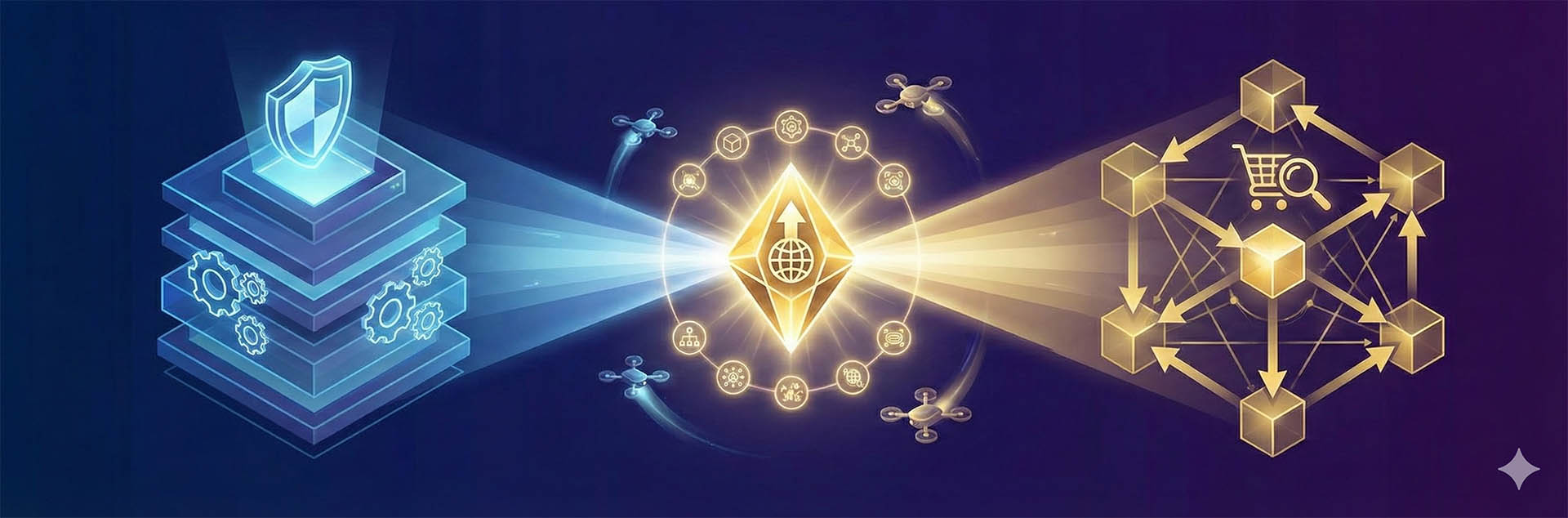
To understand why these protocols work so well together, it's essential to grasp why they must remain separate. They represent the two distinct halves of any successful agent-mediated interaction: Governance and Operations.
MSP-1: The Constitutional Layer (Who & Why)
MSP-1 is a model-agnostic, open-source protocol designed to establish a site's sovereign semantic identity. It is not about selling; it is about being. It answers the foundational questions an AI agent must resolve before taking action:
- Is this an authoritative source within its declared scope?
- What is the semantic intent of this domain or page?
- What rights govern how an AI may use this content (e.g., training, summarization, transactional facilitation)?
MSP-1 functions as a site's digital articles of incorporation and code of conduct, expressed in a form machines can deterministically interpret. It establishes eligibility: whether an agent should proceed at all.
UCP: The Transactional Layer (What & How)
Google's Universal Commerce Protocol (UCP) is a specialized, domain-specific protocol focused on the mechanics of commerce. It is designed for execution. UCP answers practical, time-sensitive questions such as:
- Is this product in stock right now?
- What does shipping cost to this location?
- Where is the API endpoint to complete a secure checkout?
If MSP-1 is the business license on the wall, UCP is the modern point-of-sale system on the counter. UCP establishes capability: whether a transaction can occur.
The Agnostic Advantage: Future-Proofing by Design
A critical design tenet of MSP-1 is that it remains strictly model-agnostic and protocol-neutral. During its development, a conscious decision was made not to reference or embed awareness of other protocols within the MSP-1 core manifest. MSP-1 does not "know" about UCP, and this is intentional.
This separation of intentions is essential for long-term architectural resilience:
1. Eliminating Obsolescence Risk
Commerce technology evolves rapidly. Today, UCP represents Google's leading edge for agent-driven transactions. Tomorrow, it could be replaced by an open consortium standard or a protocol from another major platform.
Because MSP-1 does not depend on or reference UCP, a site owner can remove or replace their commerce implementation without altering their governance layer. The site's identity, intent, and AI-use rules remain stable regardless of the operational tooling beneath them.
2. Preventing Vendor Lock-In
MSP-1 defines neutral ground. By limiting itself to semantic intent, provenance, and governance rights, it ensures that a website's foundational identity is not coupled to the ecosystem of any single technology provider.
It remains a universally readable declaration for any agent, from Google Gemini to open-source and self-hosted models.
Working in Concert: The Agent's Journey
When a sophisticated AI agent approaches a domain implementing both protocols, an efficient agentic handshake occurs. The protocols are processed sequentially, each at its appropriate stage.
A Real-World Scenario
Imagine this: A user asks their AI assistant, "Find me sustainable hiking boots under $200." The agent begins its search and discovers a promising outdoor gear retailer. Here's what happens next:
Phase 1: Eligibility & Trust (MSP-1)
Before considering a transaction, the agent resolves the site's governance layer via the /.well-known/msp.json endpoint. It determines:
- Whether the site is a primary or authoritative source
- Whether the declared AI use policy permits transactional facilitation
- Whether the site's semantic purpose aligns with the user's high-level intent (e.g., "sustainable outdoor gear")
If this eligibility check fails, the agent disengages. If it passes, trust and permission are established.
Phase 2: Execution (UCP)
With governance resolved, the agent then locates transactional capability at /.well-known/ucp.json. It shifts focus from brand-level semantics to product-level operations:
- Retrieving real-time pricing and inventory for the hiking boots
- Calculating shipping costs to the user's location
- Executing the purchase flow securely
MSP-1 answers whether the agent should act. UCP answers whether it can.
The Role of Extensions: Bridging Without Bloating
While the MSP-1 core must remain intentionally minimal, real-world systems require integration. The future of MSP-1 lies not in core expansion, but in a healthy ecosystem of optional third-party extensions.
These extensions can act as bridges between governance and operational protocols, without polluting the foundational layer. For example, a community-defined "Commerce Bridge Extension" could exist alongside MSP-1, signaling:
"Assuming you accept our MSP-1 governance terms, our preferred commerce protocol is UCP, available at this endpoint."
By keeping such integrations external and optional, MSP-1 preserves a clean, stable foundation while still supporting the rich functionality demanded by modern commerce.
Conclusion
In the rapidly evolving agentic web, architecture is destiny. By implementing MSP-1 as a stable, agnostic governance foundation, and layering Google UCP on top as a dynamic transactional engine, site owners gain the best of both worlds.
They can pursue the commerce opportunities of today without surrendering control over their digital identity tomorrow.
MSP-1 does not compete with UCP. It enables it, quietly, cleanly, and without dependency. That restraint is its foundational elegance.